
5 MIN READ · Updated Nov 6, 2026
Spider Veins vs Varicose Veins: What Is the Difference?
Spider veins and varicose veins are common conditions that affect the veins, particularly in the legs. Both can become more noticeable with age...
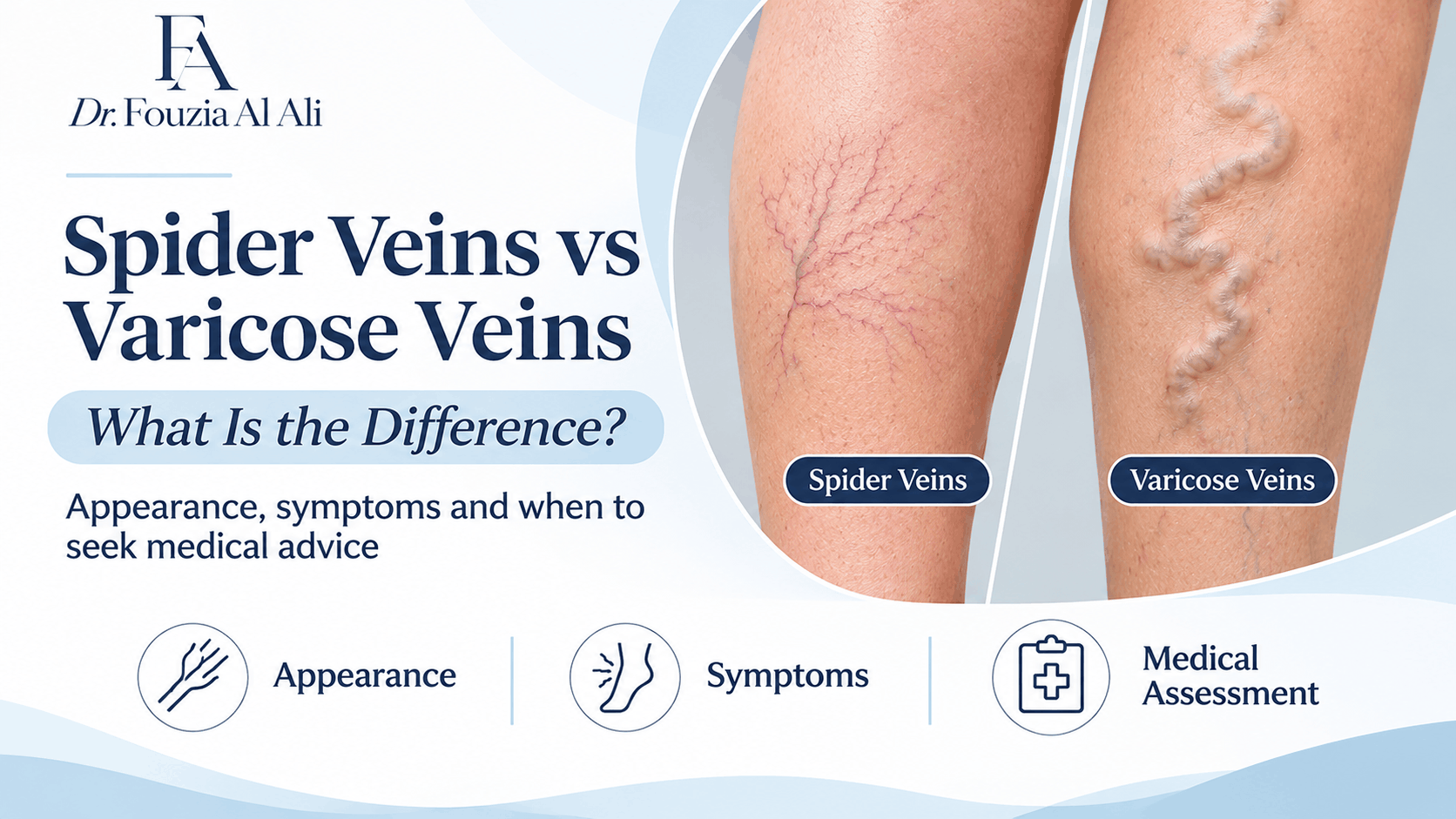
Spider veins and varicose veins are common conditions that affect the veins, particularly in the legs. Both can become more noticeable with age and may be associated with family history, hormonal changes, pregnancy or prolonged periods of standing. However, they differ in appearance, size, depth and the symptoms they may cause.
Understanding spider veins vs varicose veins can help you recognise when visible veins are primarily a cosmetic concern and when they may need medical assessment. Spider veins usually appear as fine, web-like lines close to the skin, whereas varicose veins are often larger, swollen and twisted. Although their appearance can provide useful clues, it does not always reveal whether an underlying vein problem is present.
This guide from Dr. Fawezya explains the difference between spider and varicose veins, their possible causes, associated symptoms and available treatment options.
What Are Spider Veins?
Spider veins are small, visible blood vessels that appear close to the surface of the skin. They are typically red, blue or purple and form thin lines resembling a spider's web or tree branches. They commonly develop on the thighs, calves and ankles, although they can occur in other areas of the body.
Spider veins are generally smaller than varicose veins and usually do not bulge significantly above the skin. Many people experience no physical symptoms and notice them mainly because of their appearance.
However, some people with spider veins report mild itching, burning, aching or discomfort, particularly after prolonged standing. Spider veins may also occur alongside other signs of chronic venous disease, so their presence should be considered in the context of any accompanying symptoms.
Common characteristics of spider veins
- Fine red, blue or purple lines visible beneath the skin.
- A web-like, branching or thread-like pattern.
- Usually flat or only slightly raised.
- Commonly found on the thighs, calves and ankles.
- Often associated with cosmetic concerns, although discomfort can occur.
Spider veins do not automatically indicate serious vein disease. A healthcare professional can assess whether further investigation is appropriate, particularly if there is persistent discomfort, swelling or skin changes.
What Are Varicose Veins?
Varicose veins are enlarged, twisted veins that commonly develop in the legs. They may appear blue, dark purple or skin-coloured and often protrude above the skin's surface.
Healthy leg veins contain valves that help blood travel back towards the heart. When these valves do not function effectively, blood can flow backwards and collect within the veins. This can increase pressure inside the vessels, causing them to enlarge and become more visible.
Varicose veins can range from small, noticeable veins to larger, prominent veins associated with aching, heaviness, swelling or skin changes around the ankles.
Common characteristics of varicose veins
- Enlarged, twisted or rope-like veins.
- Veins that may bulge above the skin.
- Blue, dark purple or skin-coloured appearance.
- A feeling of heaviness, aching or tiredness in the legs.
- Possible ankle swelling, itching or skin changes in more advanced cases.
Not everyone with varicose veins experiences symptoms. However, persistent discomfort, swelling, skin discolouration or sores around the ankles should be assessed by a healthcare professional.
Spider Veins vs Varicose Veins: Key Differences
Although spider veins and varicose veins may occur in the same area, they are not identical conditions. Their size, appearance, depth and associated symptoms can help distinguish them.
Feature
Spider Veins
Varicose Veins
Appearance
Fine, web-like lines
Enlarged, twisted or rope-like veins
Size
Usually small and thin
Generally larger and more prominent
Position
Close to the skin's surface
Often involve larger veins beneath the skin
Colour
Red, blue or purple
Blue, dark purple or skin-coloured
Texture
Usually flat or slightly raised
Often bulge above the skin
Symptoms
Frequently symptom-free; occasional itching or burning
May cause aching, heaviness, swelling or itching
Main concern
Often cosmetic, but symptoms may need assessment
May be cosmetic or associated with chronic venous disease
Assessment
Based on appearance and symptoms; further tests when indicated
Clinical assessment, sometimes with a venous duplex ultrasound
Treatment
Often optional when there are no concerning symptoms
Depends on symptoms, examination and underlying vein function
The difference between spider and varicose veins is not only cosmetic. Varicose veins are more commonly associated with symptoms of increased venous pressure, although the size or appearance of a visible vein alone cannot determine the severity of the underlying problem.
What Causes Spider Veins and Varicose Veins?
Spider veins and varicose veins share several risk factors. Both may develop when small blood vessels become more visible or when the circulation in the legs is affected by changes in vein function.
1. Family history
A family history of spider veins or varicose veins may increase the likelihood of developing them. Inherited differences in vein structure or valve function can contribute to their development.
2. Age-related changes
As people get older, veins and their valves may become less effective. This can make varicose veins more likely, while changes in the skin and blood vessels may also make spider veins more noticeable.
3. Prolonged standing or sitting
Spending long periods sitting or standing without moving can make it harder for blood to return efficiently from the legs. This may contribute to leg discomfort and venous pressure, particularly in people who already have a tendency to develop vein problems.
4. Pregnancy and hormonal changes
Pregnancy increases blood volume and places additional pressure on the veins in the legs. Hormonal changes can also affect vein walls. Some visible veins improve after pregnancy, although others may remain.
Hormonal changes at other stages of life may also influence the development of visible veins.
5. Excess body weight
Carrying excess body weight can increase pressure on the veins in the lower body. This may contribute to the development or worsening of varicose veins in susceptible individuals.
6. Reduced movement
The calf muscles help push blood upwards through the leg veins during walking and movement. Limited mobility reduces this natural pumping action and may contribute to circulation problems.
7. Underlying venous insufficiency
Chronic venous insufficiency occurs when the veins struggle to return blood efficiently towards the heart, often because their valves are not working properly. It is particularly relevant when varicose veins occur alongside persistent leg swelling, heaviness, skin changes or other symptoms.
Spider veins can occur without significant venous insufficiency, so the appearance of small surface vessels alone does not establish this diagnosis.
Are Spider Veins Less Serious Than Varicose Veins?
Spider veins are often a cosmetic concern and usually do not cause major medical problems. Varicose veins, however, are more commonly associated with symptoms and complications related to chronic venous disease.
That does not mean every varicose vein is dangerous or that spider veins should always be ignored. The appropriate response depends on the person's symptoms, medical history and examination findings.
Possible concerns associated with spider veins
Spider veins may cause cosmetic distress or mild local discomfort. If they occur with leg swelling, persistent pain, skin changes or larger visible veins, a medical assessment can help determine whether another vein problem is present.
Possible complications associated with varicose veins
Some people with varicose veins develop complications, including:
- Bleeding: A superficial varicose vein can bleed if the skin over it is injured or breaks.
- Skin changes: Long-standing venous pressure may cause itching, inflammation, discolouration or thickening around the ankles.
- Venous leg ulcers: Some people develop wounds near the ankles that heal slowly.
- Superficial thrombophlebitis: A superficial vein may become inflamed and develop a blood clot, causing pain, redness and firmness along the vein.
A deep vein thrombosis (DVT) is a separate condition involving a blood clot in a deep vein. It should not be confused with an ordinary spider vein or assumed to be present simply because someone has varicose veins.
When to seek urgent medical attention
Seek urgent medical assessment if one leg suddenly becomes swollen, painful, warm or red, as these symptoms can indicate DVT or another significant problem.
Sudden breathlessness, chest pain or collapse may indicate a medical emergency. Contact local emergency services immediately.
If a varicose vein bleeds, lie down if possible, raise the affected leg and apply firm, continuous pressure directly over the bleeding point with a clean cloth or dressing. Seek urgent medical care, especially if the bleeding is heavy, does not stop or you feel faint.
How Are Spider Veins and Varicose Veins Diagnosed?
A healthcare professional usually begins by asking about your symptoms, medical history and family history. They may examine your legs while you are standing to assess the location and appearance of the veins, swelling and any skin changes.
Clinical examination
The examination may help identify whether the visible vessels appear to be spider veins, varicose veins or part of a broader venous circulation problem. Your symptoms are important: aching, heaviness, swelling and skin changes may influence whether additional tests are recommended.
Venous duplex ultrasound
A venous duplex ultrasound uses sound waves to assess blood flow and the structure of the veins. It can help identify reflux, which occurs when blood flows backwards through veins because valves are not working effectively. It can also be used to investigate suspected blood clots when clinically indicated.
Ultrasound is not necessary for every person with uncomplicated spider veins. It may be recommended when varicose veins are associated with significant symptoms, recurrent problems, skin changes or suspected underlying venous disease, or when treatment planning requires a more detailed assessment.
Treatment Options for Spider Veins
Treatment depends on whether the veins cause symptoms, whether an underlying vein problem is present and whether the individual wishes to address their appearance.
1. Observation and self-care
Spider veins that cause no symptoms may not require treatment. Regular movement, avoiding long periods in one position and taking breaks to walk can support normal leg circulation and help manage discomfort.
These measures may improve symptoms but generally do not remove existing spider veins.
2. Sclerotherapy
Sclerotherapy is a commonly used treatment for selected spider veins. A clinician injects a solution into the targeted vessels, causing them to close gradually. The body then absorbs the treated vessels over time.
The number of sessions required varies according to the extent and pattern of the veins. Potential side effects include temporary bruising, pigmentation changes and, less commonly, other complications. Suitability should be assessed by a qualified clinician.
3. Laser treatment
Certain surface spider veins may be treated with vascular laser technology. Laser treatment uses targeted energy to affect the blood vessels. Its suitability depends on the size, location and colour of the veins, as well as the person's skin characteristics and medical history.
Not every type of visible vein responds equally well to laser treatment.
Treatment Options for Varicose Veins
Varicose vein treatment is selected according to symptoms, ultrasound findings when indicated, the veins involved and the person's overall health.
1. Lifestyle measures
Walking and regular calf-muscle movement can help support venous circulation. If appropriate, leg elevation may relieve swelling or heaviness. Managing body weight and avoiding long periods of sitting or standing without movement may also help reduce symptoms.
These measures can support symptom management but may not correct faulty vein valves or remove established varicose veins.
2. Compression stockings
Compression stockings apply graduated pressure to the legs and may help reduce swelling or discomfort in some people. They do not permanently eliminate varicose veins.
A healthcare professional can advise whether compression is suitable, particularly for people with conditions affecting arterial circulation or other medical concerns.
3. Endovenous treatment
Endovenous procedures, including endovenous laser treatment and radiofrequency ablation, use heat delivered through a catheter to close a problematic vein. They are commonly used for selected varicose veins associated with venous reflux.
The suitability of these treatments depends on the vein anatomy, ultrasound findings and clinical assessment.
4. Ultrasound-guided foam sclerotherapy
In selected cases, a clinician injects foam into a vein under ultrasound guidance to close it. This approach may be considered for particular vein patterns or when other procedures are not the most suitable option.
5. Surgery or other procedures
Surgical treatment or other specialist procedures may be appropriate in selected cases, depending on the vein pattern, symptoms and available treatment options. A clinician can explain the likely benefits, risks, recovery time and alternatives.
Can Spider Veins Turn Into Varicose Veins?
Spider veins do not necessarily develop into varicose veins. They are different types of visible blood vessels, and many people have spider veins without ever developing larger varicose veins.
However, both may occur in the same person because they share some risk factors. Spider veins may also appear alongside underlying venous insufficiency, which is why associated symptoms should not be overlooked.
If you notice increasing leg swelling, aching, heaviness, skin changes or new prominent veins, consider arranging a clinical assessment rather than relying on appearance alone.
How Can You Reduce the Risk of Developing More Visible Veins?
Not every case of spider veins or varicose veins can be prevented, particularly when genetics, age or hormonal factors play a role. However, some habits may support leg circulation and help manage symptoms.
- Move regularly: Walking activates the calf muscles, which help move blood through the leg veins.
- Break up long periods of sitting or standing: Change position and walk around at regular intervals.
- Elevate your legs when appropriate: This may help ease swelling after long periods on your feet.
- Maintain a healthy body weight: This can reduce excess pressure on the veins.
- Seek advice about persistent symptoms: Early assessment can help identify venous insufficiency or another condition requiring attention.
These measures may help manage discomfort and support circulation, but they cannot guarantee prevention or remove existing veins.
Conclusion
The main difference in spider veins vs varicose veins is their appearance and the size of the affected vessels. Spider veins are generally small, web-like vessels near the skin's surface, while varicose veins are enlarged, twisted veins that may be associated with discomfort, swelling and skin changes.
Both conditions are common, but treatment decisions should be based on symptoms, clinical findings and individual needs rather than appearance alone. If you have persistent leg discomfort, swelling or changes around the ankles, seek medical advice to understand the possible cause and appropriate next steps.
For patient education and guidance on visible leg veins, Dr. Fawezya encourages an informed approach that prioritises accurate assessment and appropriate care.

Consultant family physician in Dubai who practises functional medicine, Calm Mind Sessions and aesthetic medicine. She l…
FAQs
1. What is the main difference between spider veins and varicose veins?
Spider veins are small, thin blood vessels that form red, blue or purple web-like patterns close to the skin. Varicose veins are larger, twisted veins that often bulge above the skin and may cause aching, heaviness or swelling.
2. Are spider veins dangerous?
Spider veins are usually harmless and often cause cosmetic concerns rather than significant medical problems. However, if they occur with persistent pain, leg swelling or skin changes, a healthcare professional can assess whether an underlying vein condition is present.
3. Are varicose veins always painful?
No. Some people have visible varicose veins without symptoms. Others experience aching, itching, heaviness, swelling or discomfort that worsens after standing for long periods.
4. Can spider veins and varicose veins occur together?
Yes. Both can develop in the same person. Their presence together does not automatically mean that the spider veins are caused by the varicose veins, but accompanying symptoms may warrant assessment for underlying venous disease.
5. Do spider veins need treatment?
Not always. If spider veins do not cause symptoms or other concerns, treatment may be optional. People who wish to reduce their appearance can discuss options such as sclerotherapy or selected laser treatments with a qualified clinician.
6. What is the best treatment for varicose veins?
There is no single best treatment for everyone. Options may include lifestyle measures, compression stockings for symptom management, endovenous ablation, ultrasound-guided foam sclerotherapy or surgery in selected cases. The appropriate option depends on clinical assessment and, when indicated, ultrasound findings.
7. When should I see a doctor about visible leg veins?
Seek medical advice if visible veins are accompanied by persistent pain, heaviness, swelling, itching, skin discolouration or wounds near the ankles. Sudden swelling and pain in one leg, especially with warmth or redness, require urgent assessment.
8. Can exercise get rid of spider veins or varicose veins?
Exercise, particularly walking, supports circulation and may help reduce some symptoms. However, it generally does not remove existing spider veins or permanently correct the faulty valves responsible for many varicose veins.
9. Do spider veins mean I have poor circulation?
Not necessarily. Spider veins can occur without significant circulation problems. A clinician can assess whether they are isolated surface vessels or are associated with symptoms or signs of underlying venous disease.
10. Can varicose veins cause skin problems?
Yes. In some people, persistent venous pressure contributes to itching, inflammation, skin discolouration and, in advanced cases, venous leg ulcers. Skin changes around the ankles should be assessed by a healthcare professional.